Coalitions spend a lot of time thinking about how to reach young people, but what happens when you flip the script and start thinking about how to work with them instead?
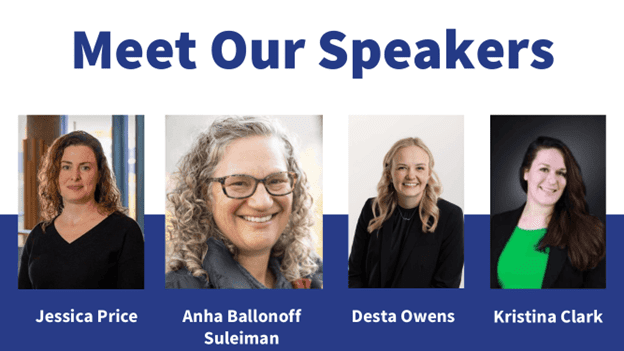
That’s the premise behind CADCA’s Youth Engagement competency, which was explored in detail in April as part of our 18-part Competencies in Focus webinar series. The session brought together Jessica Price of the Center for Public Health Systems Science at the Washington University in St. Louis, Dr. Anha Ballonoff Suleiman of the UC Davis Center for Regional Change, Desta Owens of the Empower Coalition, and CADCA Trainer Kristina Clark.
What made the development of this competency different than the others? Youth were involved in building it. They were consulted early and asked what they needed adults to understand, and they were brought back later to weigh in on what had been drafted. One phrase in the final definition traces directly back to those conversations with youth: trusted partners.
The competency defines youth engagement as collaborating with youth as trusted partners to develop, implement, and evaluate coalition strategies that address issues affecting youth.
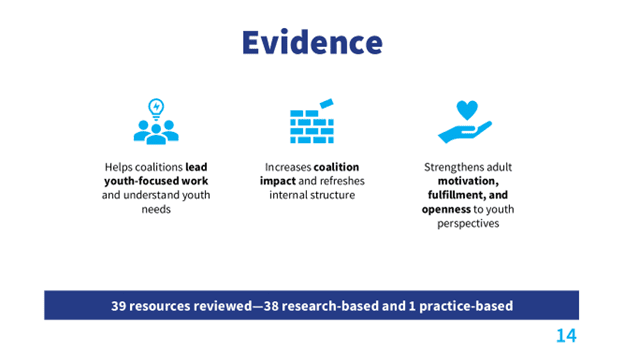
Dr. Ballonoff Suleiman introduced a concept that’s easy to overlook, adultism. This is the deeply embedded assumption that adults know best and that young people should defer to them. It shows up in multiple facets in policies, meeting structures, and sometimes in the habits of people who consider themselves strong advocates for equity. She noted that naming it is the first step to disrupting it.
Her practical guidance cut against a common misconception that more youth engagement is inherently better. The right level of engagement depends on your coalition’s capacity, timeline, and even the young people you’re working with. What matters most is being honest with yourself and with youth about where they have real decision-making power and where they don’t. Young people can handle transparency, but what erodes trust is the performance of partnership without the substance of it.
Owens then showed attendees what the substance of partnership looks like. As project coordinator for the Empower Coalition, she oversees youth groups across five high schools in Martin County, with around 100 active members and youth seats on the coalition’s executive board. The model they’ve built starts with relationships.
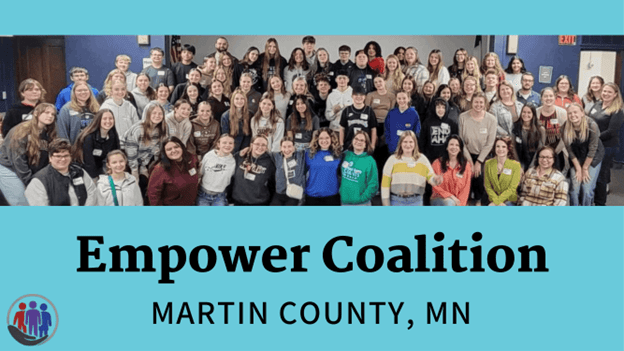
High school students visit elementary classrooms to talk about vaping, mental health, and digital wellbeing, but they also stick around afterward to shoot hoops and spend time with the kids. By the time those younger kids reach high school, Empower is a community they already feel a part of. There’s also no single way to be involved. Some students run the podcast, while others plan events or focus on advocacy. The entry point can be whatever fits each person.
According to Owens, what keeps students engaged long-term comes down to three things: they feel known, they feel needed, and they can see the impact they’re making.
Clark brought it back to the practical. Before coalitions can do any of this well, they need to look honestly at where they are. Pull out the Youth Engagement competency and review the associated knowledge, skills, and abilities. Ask where the gaps are and where adults are still doing most of the talking.
She also flagged that youth engagement can’t be added as an afterthought in response to a grant coming through. It has to be planned from the start, built into proposals, and nurtured before it’s needed. Building the relationships that make it work takes time, and the coalitions that do this well started building those relationships long before anyone asked them to.
Watch the full recording to dig deeper into youth engagement. Register for the next installment on May 11 where we explore the change management competency.

 English
 Spanish
 French
 Russian
 Portuguese