The only constant in life is change, something that most coalition leaders deal with constantly. And yet, it’s rarely something that they feel fully prepared for. This topic was front and center in CADCA’s Competencies in Focus webinar, which focused on change management.
The session featured Zara Petkovic of the Center for Public Health Systems Science at Washington University in St. Louis; nonprofit strategist Patrice Shumate of A Village for Good; and CADCA Trainer Kristina Clark. They highlighted the theory, the frameworks, and what change management looks like when you’re in the middle of it.

Before kicking off the presentation, the presenters opened with a live poll. According to the results, 84% of attendees said their organization is currently in the midst of change. Nearly half said that change was a mix of chosen and unchosen; it was both something they decided and something that happened to them. When asked whether their organization had the training and resources to move through change effectively, about half rated themselves a 3 out of 5. Most coalitions are navigating change without the tools to navigate it well. This webinar was an attempt to start closing that gap.
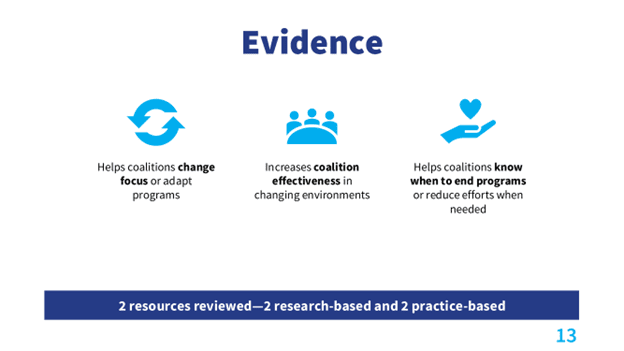
Change management is defined as making adjustments to programs, processes, policies, and practices to meet changing priorities and community needs. Petkovic added that the research behind it points to a few reasons it matters specifically for coalitions. It helps them adapt programs when coalitions shift, increases effectiveness in changing environments, and helps coalitions know when to wind something down.
The competency covers knowledge areas like understanding how local culture shapes resistance and acceptance, skills like data-driven decision-making and group facilitation, and the ability to achieve stakeholder consensus even when people are in conflict or on different sides.
Shumate shared four change management frameworks that coalitions should be aware of: Lewin’s three-stage model (unfreeze, change, refreeze); ADKAR (Awareness, Desire, Knowledge, Ability, Reinforcement); the OODA Loop (Observe, Orient, Decide, Act, then loop back); and Kotter’s model, which moves through urgency, coalition building, communication, removing barriers, and anchoring change once it’s taken hold.
Her point wasn’t that any one of these is the right answer. It’s that most organizations don’t have a model at all and winging it doesn’t work. She encouraged attendees to look at these, find what resonates, and build a process that actually fits how their coalition experiences change. Real-life change involves community dynamics, people, and external pressures that no single framework can fully account for.
She also introduced a resource called the Social Change Ecosystem Map, developed by Deepa Iyer, which maps out 10 distinct roles required for social change to happen. It’s a useful lens for coalitions to look honestly at which roles exist on their team, which are missing, and whether a few people are stretched too thin, trying to fill all of them.
Clark shared a concrete example of a coalition in Manchester, TN that was making a significant strategic shift, moving from a program-heavy approach toward environmental and policy change strategies. Getting a coalition to change how it operates, especially when people are attached to what they’ve built, is genuinely difficult.
Her approach centered on a two-day learning map series. Rather than announcing the new direction and expecting buy-in, the goal was to bring coalition members through a process that made the change feel like their own idea.
The process followed a scan, focus, act structure. The scan phase consisted of getting people out of their usual thinking by presenting new data, sharing how other coalitions had approached similar challenges, and creating space for members to look at things they hadn’t been looking at together. The focus phase was where the group developed a shared vision, not just agreement that substance use is a problem, but a specific understanding of the gap between where things are and where they want them to go. The act phase made sure no one left the room without committing to something specific.
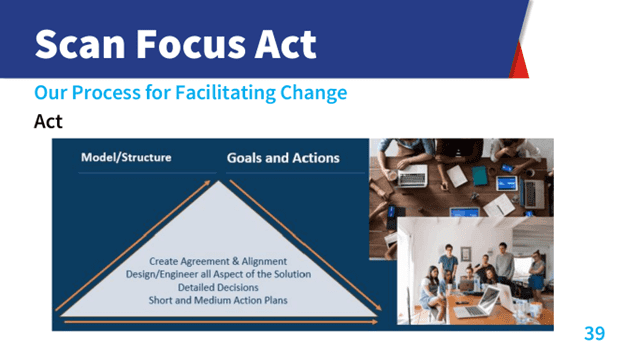
What made it work was the intentionality around who was in the room and what they were asked to do. Coalition members from 12 sectors were each asked to bring others from their sector. Those 12 sectors consist of youth, parents, businesses, media, schools, law enforcement, healthcare professionals or organizations, religious and fraternal organizations, youth-serving organizations, government agencies, civic and volunteer groups, and others working to reduce substance use. They represent the mandatory cross-section of stakeholders that every DFC-funded coalition is required to engage, because preventing youth substance use requires input from the whole community. They prioritized data points that spoke to them specifically. They worked through scenarios in small groups. By the end of the discussion, they had built a community plan, and they each had a piece of it.
The results were clear. Police departments, city and county governments, businesses, and faith communities each embedded coalition goals into their own strategic plans. Policies were passed, such as retailer compliance checks, responsible beverage service training, and social host ordinances. Staff were able to do more with less because partners were carrying the work.
For more insights, watch the webinar recording. The next webinar in the series on June 30 will focus on the Implementation competency. Register here.

 English
 Spanish
 French
 Russian
 Portuguese