Coalitions can have a good strategy on paper, but what determines whether it actually changes outcomes is implementation, the day-to-day work of putting that strategy into practice. That was the focus of the Competencies in Focus: Implementation webinar, the 13e session in CADCA’s 18-part Coalition Competencies webinar series, presented in partnership with the Center for Public Health Systems Science (CPHSS) at Washington University in St. Louis.
CPHSS researchers Zara Petkovich and Anna La Manna joined youth prevention leader Mudra Machewad and CADCA national trainer Kristina Clark to walk through what it takes to move an evidence-based strategy from plan to practice.
Petkovich kicked things off by defining the Implementation competency as putting evidence-based interventions into routine use in a specific setting, whether that’s a health clinic, a school, or a community at large. When done well, it ensures that strategies are carried out as intended and leads to stronger public health outcomes.
La Manna, who manages research translation at CPHSS, made the case that implementation science doesn’t have to sound academic. The research tells us what works, and implementation science tells us how to make it work in the real world.
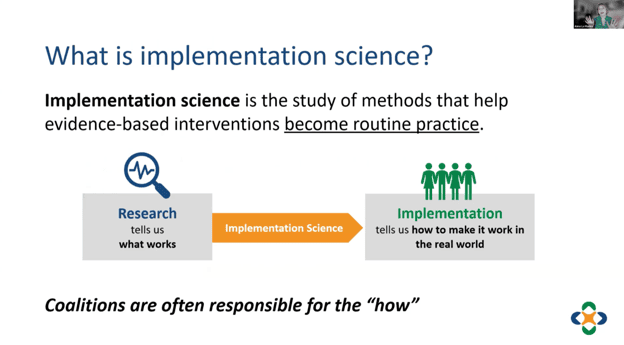
For example, researchers develop and test a recipe. Implementation science asks how hundreds of different kitchens, each with different staff, resources, and populations, can successfully make that same meal. Coalitions are uniquely positioned to help, because they bring together partners who might not otherwise be in the same room: schools, public health agencies, policymakers, health systems, and community organizations. Change rarely happens because one organization acts alone; rather, it happens when multiple partners work toward a shared goal.
Before implementing anything new, La Manna encouraged coalitions to ask five questions:
- What are we implementing?
- Who needs to change what they do?
- What support will they need?
- How will we know if it’s working?
- How will we sustain it?
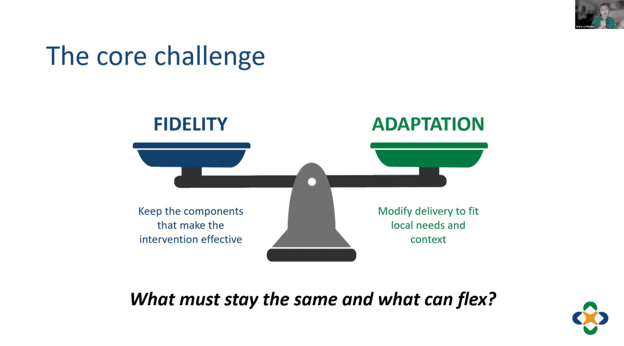
She also introduced a second analogy, the cake, to explain the balance between fidelity and adaptation. Core ingredients (the essential components of an evidence-based practice) can’t be swapped or removed without changing the outcome. However, plenty can be adapted, like shape, decoration, or format, without changing what makes the cake a cake. The guiding questions when adapting: Does this improve fit? Increase access? If yes, you’re likely preserving the core while adapting to your community.
Other key lessons from the webinar include:
- Implementation challenges are often capacity challenges. Before asking partners to do something differently, ask them what support would help them succeed.
- Start small and learn fast. Pilot with one organization, one school, one clinic. Use a Plan-Do-Study-Act cycle to test and refine before expanding.
- Document adaptations as you go. Otherwise, coalitions lose the institutional knowledge of what changed and why, and can’t replicate or share what worked.
- Scale proven approaches, not promising ideas. Before expanding, confirm that the approach is producing intended results, is feasible, and that partners have the capacity to support growth. An implementation playbook and peer mentoring make scaling easier.
- Think about sustainability from day one. Warning signs of fragility include reliance on a single grant, a single champion, or unclear ownership. Aligning with organizational priorities, engaging leadership early, diversifying funding, and embedding activities into existing roles all build staying power.
- Use the RE-AIM framework (Reach, Effectiveness, Adoption, Implementation, Maintenance) to evaluate not just outcomes, but the implementation process itself. When results fall short, the issue may not be the intervention. It may be limited participation, inconsistent delivery, or low adoption.
Machewad, founder of the Lake Safe Initiative and a member of CADCA’s National Youth Leadership Council, brought the framework to life with her own coalition’s story.
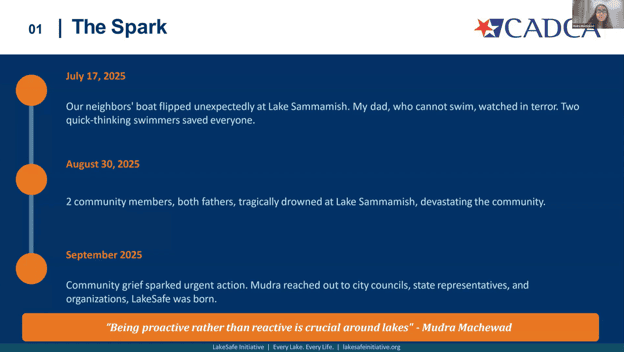
After a near-drowning and, weeks later, the deaths of two community members at Lake Sammamish in Washington State, Mudra began reaching out to city councils, state representatives, schools, and public health leaders, with no organization or funding behind her yet, just a problem that needed attention. Research backed up what her community was feeling: King County has seen roughly 190 drowning deaths since 2018, more than half in open water, and substance use is a frequent contributing factor nationally and in her own data collection with Influence the Choice.
From there, Lake Safe followed the same implementation playbook the researchers described:
- Started small, piloting multilingual signage and life jacket loaner station concepts at one location, Lake Sammamish State Park.
- Adapted based on feedback, revising messaging to be multilingual and culturally relevant to the communities using the lake.
- Coordinated existing resources rather than duplicating effort, partnering with organizations like the YMCA and Washington State Parks.
- Let partners self-select their role. Instead of assigning tasks, Machewad shared the problem and let each of the initiative’s 19+ partner organizations decide where their expertise fit best, building stronger ownership and buy-in.
- Kept people engaged through monthly all-hands meetings, where partners share progress and next steps.
So far, more than 5,000 community members have been reached, 2,000+ one-on-one prevention conversations have been held, and a 19-plus-organization coalition was created in addition to a community-wide event called the Lake Safe Confluence. Machewad’s four lessons for other coalitions: start with your community’s pain point, let partners discover where they fit, don’t be afraid to start small, and remember that young people are today’s implementers.
Clark, president of KM Clark Consulting Group and a longtime CADCA national trainer, closed with a challenge for coalitions applying the strategic prevention framework: the question isn’t “did we do it?” It’s, “How do we make it successful?”
Her 30-day call to action: pick one evidence-based strategy that your coalition is currently implementing, bring your partners together, and ask whether you’re implementing it with fidelity, whether it still fits your community, and whether a small tweak could strengthen it. Identify one improvement, test it, collect feedback, and decide whether to adapt, continue, or scale. Treat implementation as a continuous conversation rather than a one-time checkbox.
For more insights, watch the full webinar here. The next installation of the Competencies in Focus webinar series, focusing on the Planning competency, will take place on Thursday, August 27 at 2 PM.