CADCA recently hosted the seventh webinar in our 18-part Competencies in Focus webinar series, continuing the conversation around what it truly takes for coalitions to be effective and sustainable. This session focused on the Leadership competency, which is needed to navigate change and maintain a shared vision over time.
The webinar featured insights from Zara Petkovic of the Center for Public Health Systems Science (CPHSS) at the Washington University in St. Louis; Julie Hook, community strategist with PreventEd and program director of the HOPE for Franklin County Coalition; and Kristin Bengston, the director of community services at PreventEd.
Petkovic opened the session by reviewing the background and purpose of the coalition competencies and highlighting the knowledge, skills, and abilities associated with the leadership competency. CADCA’s Coalition Competencies cover three areas: operations, community, and prevention, and provide a comprehensive view of what is needed for a coalition to be successful as a whole.
Leadership is defined as creating and communicating a shared vision for a changing future, including championing solutions to organizational and community challenges and building partnerships. The evidence consistently shows that strong leadership contributes to coalition capacity, effectiveness, and sustainability. It helps engage members, increase community readiness, and move coalitions forward while maintaining their vision over time.
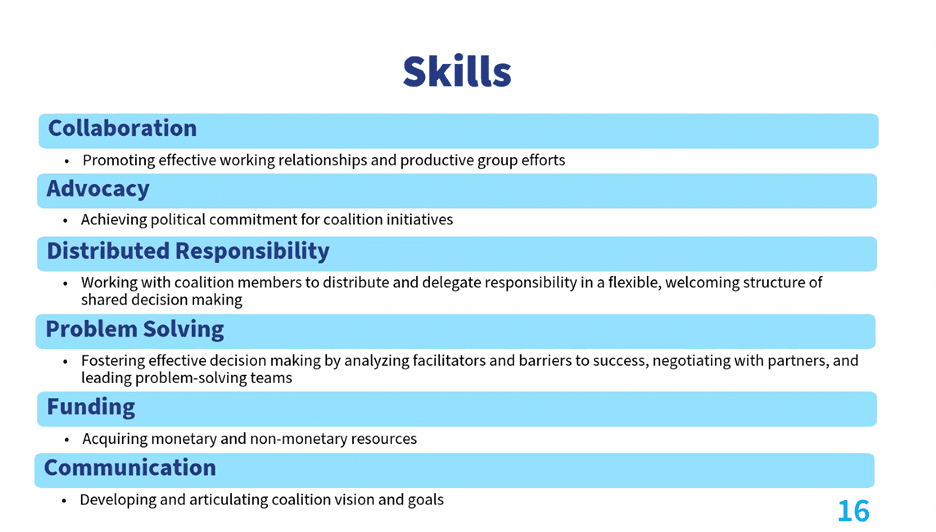
The skills needed to be competent in leadership are collaboration, advocacy, distributed responsibility, problem solving, funding, and communication.
Bengston shared an overview of PreventEd, Missouri’s Prevention Resource Center serving Eastern Missouri.
Hook then walked participants through the evolution of leadership within the HOPE for Franklin County Coalition (Healthy Outcomes through Prevention Education). HOPE is a Drug-Free Communities (DFC)-funded coalition now in its eighth year, serving all of Franklin County, Missouri.
Hook has been involved with the coalition for 16 years, first as a community member raising her family in Franklin County, then through coalition support at PreventEd, and eventually as the coalition’s program director. Over that time, she’s seen firsthand how leadership and the coalition itself has continually evolved.
In 2009, Franklin County faced a significant methamphetamine lab crisis, with labs operating in homes and deeply impacting families. In response, community leaders came together through a grassroots effort that led to the creation of a nonprofit organization, Foundations for Franklin County. Leadership at the time included law enforcement, a treatment court judge, a pediatric physician serving families involved with child services, and leaders from the children’s division.
That effort resulted in county-level policy requiring a prescription for pseudoephedrine, a key ingredient in “shake-and-bake” meth labs. While the policy success could have marked the end of the group’s work, strong leadership and cohesion led the group to continue and expand its focus to related issues like drug-endangered children and prescription drug safety. Over time, the coalition pursued funding opportunities, applied twice for DFC funding, and ultimately secured federal support.
Hook shared this history to illustrate how leadership develops over time and how coalitions can adapt rather than dissolve once an initial goal is met.
Kristin emphasized that coalition leadership is fundamentally different than leadership in more traditional organizational structures. Coalition leaders have the difficult task of navigating shared power, varied partners, and evolving community needs, often without direct authority. She also noted that leadership isn’t something you check off a list or master overnight. It’s ongoing professional development that requires continuous reflection, learning, and adjustment throughout your career.
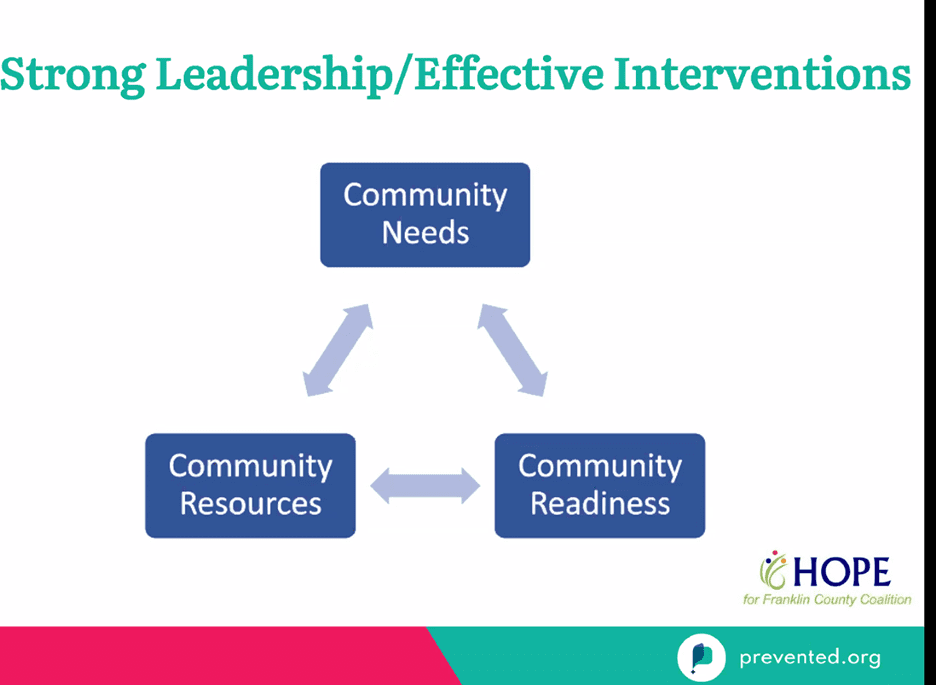
Hook also cautioned against assuming that strong leadership automatically leads to successful outcomes. While leadership and effective interventions are correlated, one does not guarantee the other. Even the most capable leader must continually assess community readiness and ensure strategies align with current needs.
She shared an example from Franklin County, where a quarter-cent sales tax initiative passed to fund youth services. While HOPE didn’t directly access those funds, the initiative strengthened the broader system by increasing resources for partner agencies. That shift expanded collaboration opportunities, improved relationships, and supported smoother leadership transitions across organizations.

Hook also emphasized that strong leadership is an ongoing process. Whether you’re a new coalition member, first-time leader, or a seasoned professional stepping into a new role, the same foundational process applies. Effective leaders must be able to access and understand relevant information, apply it through the lens of their community’s needs, and communicate it clearly and accurately to coalition members, partners, and the broader public. As community needs shift, leaders must be responsive and adjust their approach based on what their coalition needs at any given time.
The presenters also walked through multiple coalition snapshots to show how leadership skills can develop at different stages. To learn more about effectively applying the leadership competency to your coalition work, watch the webinar recording here.